
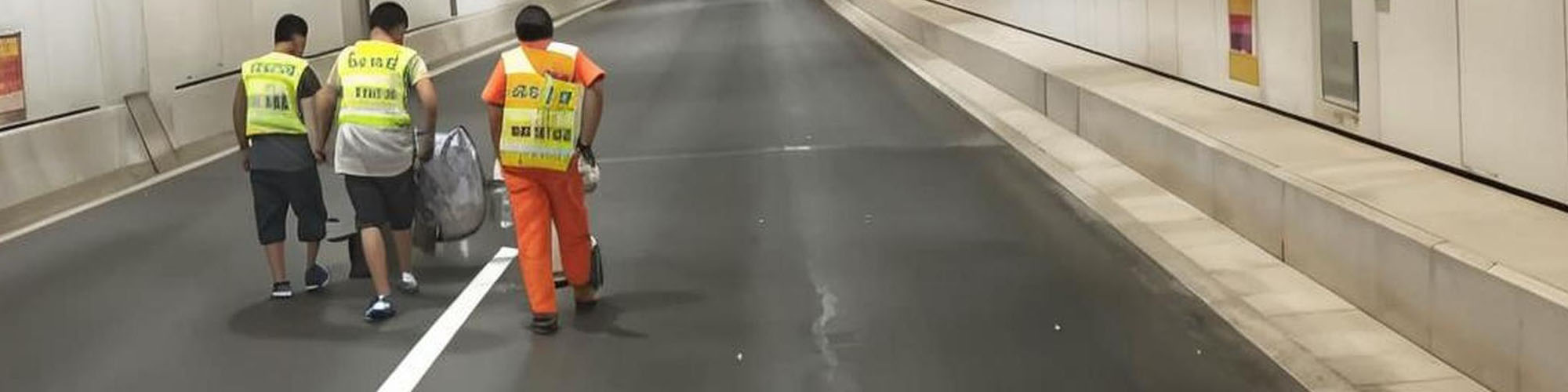
In the continuous development of industrial parks, factory safety production relies on proper ground markings. These markings serve not only as visual indicators but also as vital safeguards for ensuring safety and improving operational efficiency. For areas integrating industrial and warehousing functions, meticulous road markings within the facility are particularly vital.
1. The Necessity and Functions of Factory Ground Line Marking
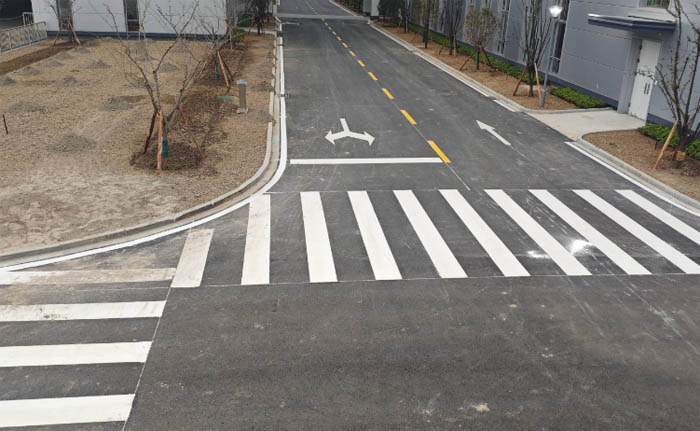
As primary sites for industrial production, the rational layout of traffic flow within facilities directly impacts production efficiency and workplace safety. Key functions of facility ground markings include: clearly defining vehicle routes, delineating parking zones, indicating hazardous areas and safety passages, and guiding operational zones and equipment placement areas. Implementing a scientifically designed marking system effectively reduces traffic conflicts and accidents, thereby enhancing overall site management standards.
Factory ground markings not only provide directional guidance but also direct vehicles along predetermined routes, preventing hazards caused by arbitrary driving. For workers, clear markings facilitate rapid understanding of workshop layouts, boosting operational efficiency. Factory markings serve not merely as visual cues but as a critical component of comprehensive safety management systems.
2. Factory Road Marking Standards and Design Principles
Factory road marking design must balance practicality and standardization to ensure user convenience and safety. Specifically, the design phase should consider the following aspects:
- Reasonable Layout for One-Way and Two-Way Traffic: Based on road width and traffic flow, appropriately designate one-way or two-way traffic to prevent congestion and traffic chaos.
- Standard Lane Widths: Maintain lane widths within reasonable limits to ensure smooth vehicle flow while accommodating pedestrian and forklift safety.
- Parking Space Allocation: Scientifically designate parking zones based on total area and parking demand, preventing encroachment on sidewalks, fire lanes, or material storage areas.
- Integration of traffic signs: Complement ground markings with vertical signs like directional arrows, no-parking lines, and crosswalks to form a comprehensive traffic guidance system.
- Road segment and intersection markings: When marking road segments, consider turning radii and intersection sightlines to ensure markings are clear and easily identifiable for drivers to follow.
During the design process, strict adherence to relevant national and industry standards is mandatory, with optimizations tailored to the specific conditions of the factory site. For instance, update the classification, shape, color, and positioning of markings according to the latest standards to ensure clear right-of-way rules and reduce the risk of wrong-way driving.
3. Road Marking Material Types and Selection Guide
Selecting appropriate materials is critical for both the environmental impact and service life of markings. Common road marking materials come in various types, each suited for different application scenarios and traffic conditions.
| Material Type | Key Characteristics | Typical Applications in Factory Settings | Sustainability Notes |
| Thermoplastic | Highly durable, excellent reflective properties, ideal for high-traffic areas. | Main traffic arteries, highway entrances/exits, areas with high vehicle traffic. | Long service life reduces frequency of renewal, lowering long-term environmental impact. |
| Cold Paint (Waterborne) | Quick-drying, cost-effective, less durable than other options. | Low-traffic areas, temporary markings, interior warehouse lanes. | Lower VOC emissions, more environmentally friendly during application. |
| Two-Component (MMA/Plastic) | Excellent durability and adhesion, high abrasion resistance, solvent-free, high skid resistance. | Busy intersections, pedestrian crossings (zebra crossings), cycle paths, areas with high turning stress. | Considered highly sustainable for urban and industrial use due to extreme durability and minimal microplastic emission. |
The principle of “sustainability through durability” is key: the longer a marking lasts, the fewer resources are consumed for renewal, and the lower the overall environmental burden -7. For areas with high stress like pedestrian crossings, materials providing maximum slip resistance are essential for safety.
4. Construction Process and Technical Essentials for Line Marking
Construction is the critical phase that determines the effectiveness of the final marking. A scientific construction process can greatly enhance the durability and clarity of the lines. The main stages include preparation, application, and acceptance.
4.1 Preparation Phase
Before construction begins, the application area must be thoroughly cleaned, including removing debris, dust, and oil stains, to ensure the surface is flat and dry . It is also necessary to review the design drawings, confirm line positions, and make clear markings . Choosing the appropriate line marking material is also key, typically selecting wear-resistant and weather-resistant specialized paints or plastics.
4.2 Application Phase
During the application phase, professional road marking machines are employed . Commonly used equipment includes cold paint road marking machines and thermoplastic road marking machines .
- Cold Paint Road Marking Machines: Often used for urban settings or interior applications where quick drying is essential . Airless systems dominate fast, cost-sensitive work, using high-pressure pumps to deliver crisp edges with minimal overspray .
- Thermoplastic Road Marking Machines: Known for their precision, speed, and efficiency, these machines can cover large areas quickly, reducing project time and labor costs . Kettle capacity, heat-up rate, and agitation uniformity are critical for productivity and bead embedment .
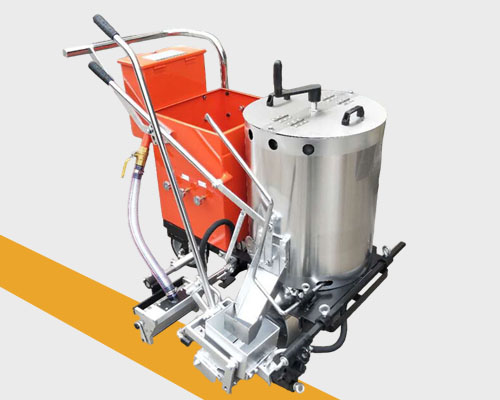
During spraying, controlling the paint thickness and drying time is crucial to avoid runs or uneven application . For special areas such as zebra crossings or arrows, different colors or symbols should be used for distinction .
4.3 Acceptance Phase
After construction is complete, acceptance checks must be conducted to inspect the smoothness, color consistency, and adhesion of the lines, with necessary touch-ups performed . Key inspection items include the color, width, thickness, segment spacing, angle, skid resistance, and retroreflection coefficient of reflective markings . After construction, measures should be taken to protect the markings from being run over by vehicles or damaged by other machinery to ensure long-lasting durability .
Technical essentials also include selecting materials suitable for the environment, ensuring appropriate construction temperature and humidity, and arranging construction time reasonably to avoid adverse weather conditions . Construction personnel must comply with operational regulations to ensure both safety and quality .
Conclusion
Factory ground line marking is a crucial component of industrial infrastructure, directly impacting traffic safety, management efficiency, and the overall quality of the working environment. Scientific design, standardized construction, and reasonable maintenance are all essential links in ensuring the effectiveness of these markings.
The choice of materials, from durable thermoplastics for high-traffic areas to sustainable MMA for pedestrian zones, must align with the specific demands of each area . Furthermore, the utilization of modern road marking machines equipped with precision technologies ensures that lines are applied accurately and durably, meeting the rigorous demands of busy factory environments .