
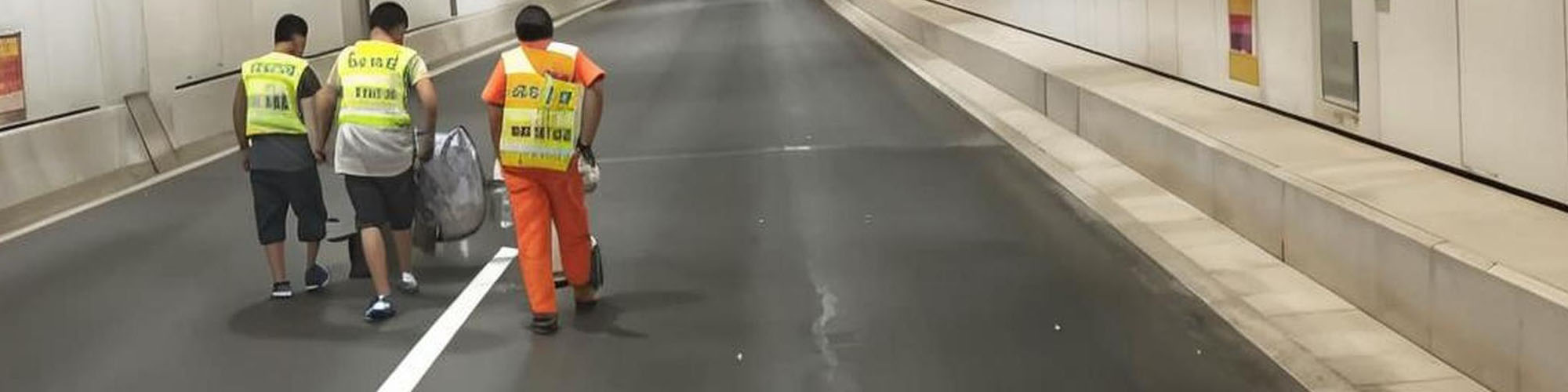
Have you ever been driving on a highway and suddenly heard a loud “boom-boom-boom” as your tires rolled over a textured section of the road? That is not a pavement defect—it is a carefully engineered safety feature known as vibra line road marking, also commonly called convex road marking, rumble strips, or vibration markings. But why does it make this distinctive sound, and how does it save lives?
The Core Mechanism: Tactile + Acoustic Dual Warning
The primary function of highway rumble strips is to provide drivers with immediate tactile and auditory warnings. This dual-warning system is particularly crucial for fatigued, distracted, or inattentive drivers navigating complex road sections. When a vehicle’s tires roll over these raised road markings at high speeds (typically exceeding 60 km/h), two physical phenomena occur simultaneously:
- High-frequency vibration: The repeated compression and release of the tires against the raised road markings generate mechanical vibrations, which are transmitted to the steering wheel, chassis, and seat.
- Loud acoustic noise: Air is rapidly compressed and expelled from the cavities between the raised markings, producing a loud “humming” or “rumbling” sound.
This sound is deliberately designed to exceed ambient highway noise (by 10–15 decibels), ensuring it remains noticeable even with windows closed, music playing, or in heavy traffic.
Where Are Convex Road Markings Installed?
These raised markings are not random. Traffic engineers place them in high-risk zones where attention lapses could lead to catastrophic crashes. Typical locations include:
- Sharp curves & bends – to pre-warn drivers to reduce speed.
- Tunnel entrances/exits – where sudden light changes affect visibility.
- Freeway ramps & interchanges – to prevent lane drift.
- Toll plazas & bridges – for controlled deceleration.
- Wet, icy, or slippery pavements – to encourage cautious driving.
Types of Convex Road Markings (Vibra Line Patterns)
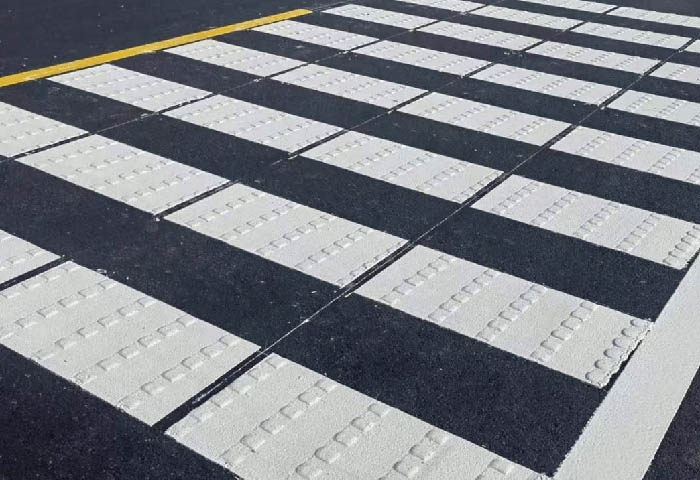
Depending on the application, vibra line road marking can be manufactured in several patterns using a convex line road marking machine. Common shapes include:
| Pattern | Application | Noise/Vibration Level |
|---|---|---|
| Square blocks | Lane edge lines | High |
| Dot matrix | Center lines (no-passing zones) | Medium |
| Continuous bars | Approach zones (toll booths, intersections) | Very high |
| Wavy lines | Speed reduction zones | Medium-high |
Advantages of Vibrating Markings Over Traditional Markings
Unlike standard flat road markings, convex road marking offers multiple safety and operational benefits:
- Enhanced Driver Alertness
Sudden vibrations and rumbling serve as a warning, immediately alerting drivers to lane drift or impending hazards. This method is particularly effective in preventing single-vehicle run-off-road accidents, which account for nearly 40% of highway fatalities. - Natural Speed Control
Rumble strips physically remind drivers to slow down before intersections, school zones, residential streets, or sharp curves without relying solely on speed cameras or signs. This passive speed management method is cost-effective yet highly effective. - Cost-Effective Safety Solution
Compared to installing guardrails, concrete barriers, or electronic warning systems, the installation and maintenance costs of rumble strips are relatively low. Modern raised pavement marking machines can complete installation quickly and precisely, minimizing disruption to traffic. - High Visibility in All Weather Conditions
Unlike paint, which fades easily in rainy or dark conditions, high-quality raised pavement markings incorporate glass beads or reflective pigments, ensuring they remain clearly visible in low light, fog, and heavy rain. The raised profile also maintains its reflective properties longer than flat markings. - Lane Discipline and Guidance
These markings serve as “tactile lane guidance.” When a driver unintentionally drifts out of their lane (for example, due to fatigue or distraction), the tactile feedback prompts the driver to immediately correct their course, thereby reducing side-impact and head-on collisions.
How Are Convex Road Markings Installed?
The manufacturing process requires specialized equipment. A convex line road marking machine applies thermoplastic or cold-plastic material through a profiled extrusion die or spray gun with template. Key steps include:
- Surface preparation: Cleaning and priming the asphalt/concrete.
- Material heating: Thermoplastic resin is heated to ~200°C.
- Application: The machine deposits material in controlled raised patterns (e.g., 3–5 mm height, 10–20 mm spacing).
- Glass bead drop-on: For immediate retroreflectivity.
- Curing: Cooling to form a durable, skid-resistant profile.
Modern machines allow adjustable convex height, spacing, and pattern, enabling customization for different speed zones and road types.
Small Bumps, Big Impact
The loud noise and vibration you feel when driving over vibra line road marking are not a nuisance, but a life-saving signal. Combining tactile feedback with audible warnings, rumble strips effectively reduce speed, prevent vehicles from drifting out of their lanes, and heighten driver alertness in high-risk areas. Backed by efficient convex line road marking machine technology, this cost-effective solution continues to make highways safer for everyone.
📌 Related Reading: For a deeper technical insight into thermoplastic convex markings and construction equipment, read our full guide: Convex Line Marking and Its Construction Machinery.