
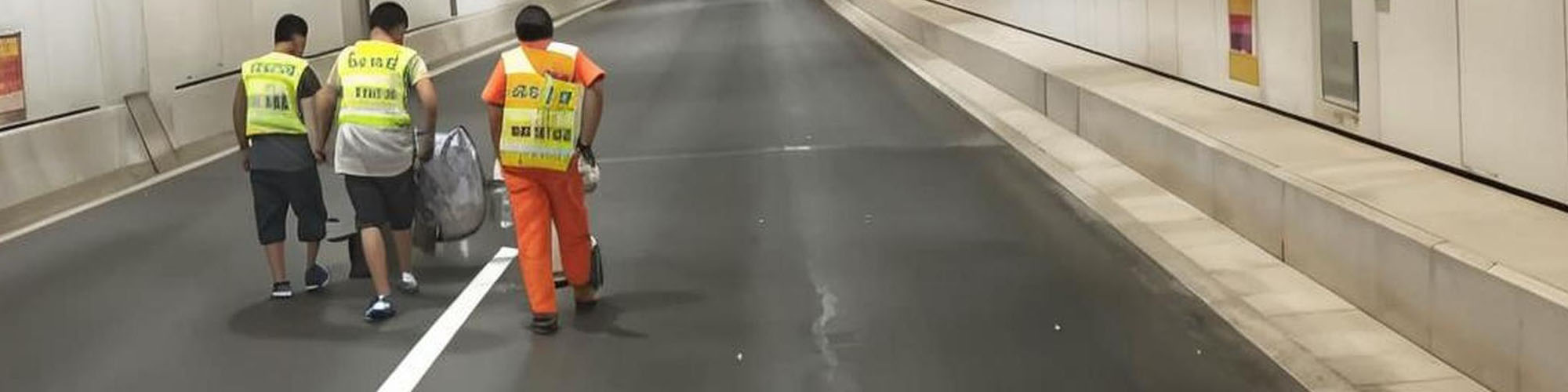
For any road marking contractor, selecting the right thermoplastic melting kettle (also known as a thermoplastic preheater) is one of the most critical decisions. The right melting kettle can improve fuel efficiency, reduce material waste, and ensure a stable extrusion flow rate for the road marking machine.
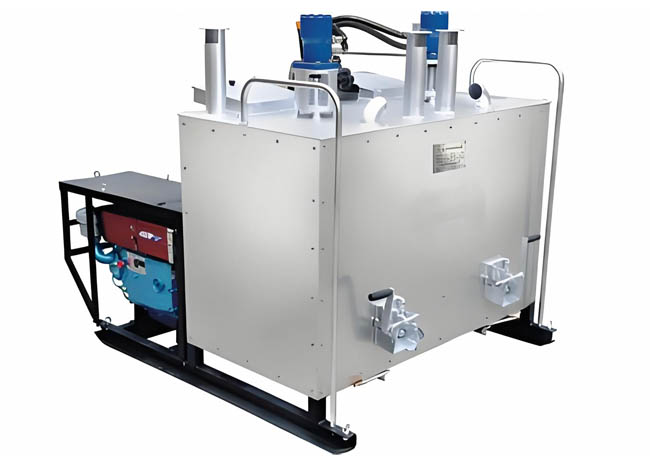
1. Melt Tank Capacity – Match Production Capacity to Project Scale
Capacity is measured by total working volume (liters or gallons), but effective capacity is typically 70–80% of the total volume to account for melt expansion and agitator scraping.
- Small projects (parking lots, warehouse floors, crosswalks): A single-jacketed melt tank with a capacity of 100–300 liters is sufficient. This type of tank supports 1–2 spray bars and allows for quick color changes.
- Medium-sized municipal projects (city intersections, bike lanes): A 400–600-liter double-jacketed melt tank equipped with a separate combustion chamber.
- Highway and runway projects: An 800–1,200-liter double-cylinder or large-capacity melt tank, typically equipped with an on-demand melt feeder to keep the main melt tank at optimal fill levels.
Key Metrics: Melt output rate (kg/h) is a more meaningful indicator than initial capacity. High-quality thermoplastic melt kettles should achieve a minimum output of 400–600 kg/hour during continuous operation on a road marking machine.
2. Heating Speed – Thermal Oil Heating vs. Direct-Fired Heating
Heating speed determines idle time and fuel consumption. Currently, there are two main technologies:
- Oil-jacket (thermal fluid) heating: Uses circulating thermal oil. This ensures uniform tank wall temperatures (temperature difference ±3 °C), thereby reducing scorching. Heat-up time: Reaches 180–200 °C in 45–75 minutes, depending on burner power (80,000–150,000 kcal/h).
- Direct-fired (flame tube) heating: Heats up faster (25–40 minutes) but results in a greater wall temperature gradient (±15 °C). Suitable for high-throughput operations with short preheating windows, but requires stricter viscosity monitoring to prevent polymer chain breakage in thermoplastic adhesives (e.g., C5/C9 petroleum resins).
Recommendation: For high-end road marking machine integration, select a melter equipped with dual independent burners and a variable-speed circulation pump to adjust heat transfer based on ambient temperature and material feed rate.
3. Fuel Types – Cost, Availability, and Emissions
Common fuels for thermoplastic melters:
- Diesel/Ultra-Low Sulfur Diesel (ULSD) – High energy density (35.8 MJ/L), abundant supply. When used with forced-draft atomizing burners (e.g., Riello or Weishaupt), combustion efficiency can reach 85–92%.
- Liquefied Petroleum Gas (LPG)/Propane – Burns cleaner with lower nitrogen oxide (NOx) emissions, but has a lower volumetric energy content (25.3 MJ/L). Suitable for indoor or tunnel applications with limited ventilation.
- Resistance Heating – Zero on-site emissions, but slower heating rates and higher operating costs (3–4 times that of diesel). Suitable only for ultra-compact mobile road marking machine trailers.
Pro Tip: When operating at altitudes above 1,500 meters, check the burner nozzle size and pump pressure (diesel pumps typically operate at 10–14 bar) to ensure altitude compensation—air density affects flame stability and heat transfer rates.
4. Mixing Performance – Agitator Design and Shear Control
The uniformity of molten thermoplastic materials depends on the agitator’s geometry and rotational speed. Inadequate mixing can lead to pigment settling (TiO₂ stratification) and filler agglomeration (CaCO₃ / glass beads).
- Single-shaft paddle agitator – Suitable for low-viscosity compounds (viscosity < 3,000 cP at 200 °C). Rotational speed: 20–40 RPM.
- Double-shaft counter-rotating agitator – Suitable for materials containing glass beads. Provides both axial and radial flow, reducing dead zones near the bottom of the reactor.
- Variable Frequency Drive (VFD) – Adjusts shear rate to accommodate different resin systems (e.g., alkyd-modified resins versus aliphatic resins). The speed is set to 50–60 RPM during initial melting and then reduced to 25–30 RPM during spraying to minimize air entrainment.
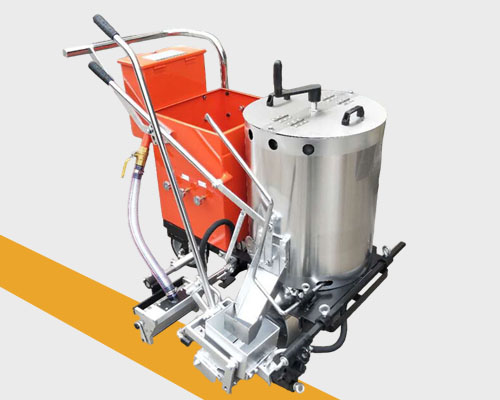
5. Temperature Control Accuracy – PID Controller vs. Switching Thermostat
Temperature instability leads to viscosity fluctuations, which in turn cause uneven film thickness (typically 1.5–2.5 millimeters for traffic markings) and reduce retroreflectivity.
- Switching Control – Temperature fluctuation range is ±10 °C. Suitable only for batch melting operations followed by scraping to ensure flatness.
- PID (Proportional-Integral-Derivative) controller with dual thermocouples (one located inside the oil jacket and one inside the melt) – Achieves temperature stability of ±2 °C. This is critical for road marking systems using screw extruders or gear pumps, as the flow rates of these devices are highly sensitive to temperature.
- Over-temperature safety: To comply with EN 1537 or ASTM E2740 standards, the hot fluid circuit must be equipped with redundant high-temperature limit cut-off devices (manually reset) and a rupture disc relief valve.
6. Cleaning and Maintenance – Wear Parts and Ease of Maintenance
Thermoplastic residues (especially EVA or SBS-modified adhesives) carbonize at temperatures above 220°C. Ease of cleaning directly impacts downtime and material cross-contamination.
- Hinged lid with full-opening design – Allows manual scraping and visual inspection of the internal wall.
- Removable burner assembly – Facilitates quarterly cleaning of the flame tube and baffle fins.
- Replaceable agitator blades – Replaceable hardened steel blades (HRC 50–55) can be changed without draining the thermal oil.
- Self-draining bottom valve – A 2-inch ball valve with a Teflon O-ring ensures complete material drainage, reducing the buildup of cured particles.
7. Mobility and Transportation Methods – Trailer-Mounted vs. Skid-Mounted
The configuration of the road marking machine determines how the mixing tank is mounted:
- Skid-mounted kettles – Bolted to a flatbed truck or large trailer platform. Offers the largest capacity (up to 1,200 liters), but requires a separate crane for unloading.
- Trailer-mounted units – Single-axle or tandem-axle with leaf-spring suspension. Include electric brakes and LED lighting for highway towing. Check axle load rating—a full 800 L kettle with oil and agitator can exceed 2,200 kg.
- Crawler-mounted/self-propelled – Integrated with the road marking machine chassis, operable by a single person. Due to center-of-gravity restrictions, capacity is typically limited to 300–500 liters.
Dimension check: Verify overall height (with lid open) and width—many tenders specify a maximum transport envelope (e.g., 2.55 m width in EU, 8.5 ft in US) to avoid escort vehicles.
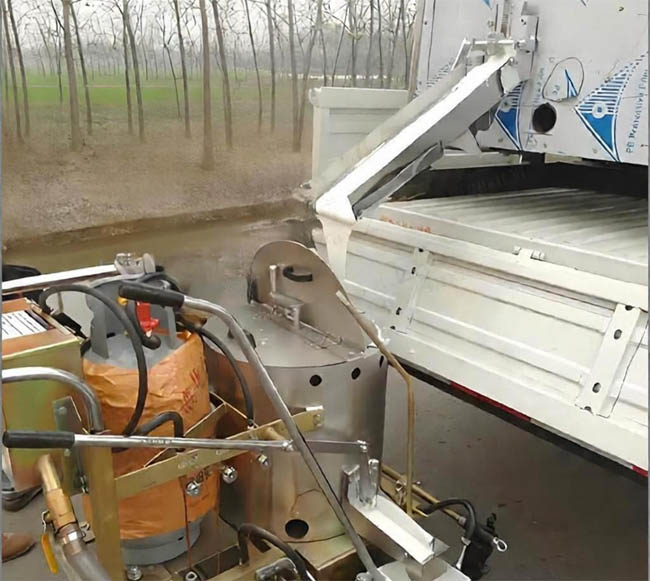
Decision Matrix – Small vs. Highway-Grade Projects
| Criteria | Compact Preheater (100–300 L) | Twin-Cylinder High-Capacity (600–1200 L) |
|---|---|---|
| Typical application | Parking lots, playgrounds | Motorways, airport runways |
| Melt rate | 150–250 kg/h | 500–900 kg/h |
| Burner power | 50–80 kW | 120–200 kW |
| Agitator type | Single paddle with VFD | Double counter-rotating |
| Temp. precision | ±5 °C (on/off) | ±2 °C (PID + oil jacket) |
| Cleaning time | ~1.5 h manual | ~3.5 h with flush cycle |
| Road marking machine compatibility | Hand-guided or mini-trucks | Truck-mounted or large tow-behind |
Need a custom comparison? Please contact our technical sales team and provide your project’s daily output, target glass bead retention rate, and local fuel type—we’ll match you with the thermoplastic melting kettle best suited for your road marking machine fleet.