
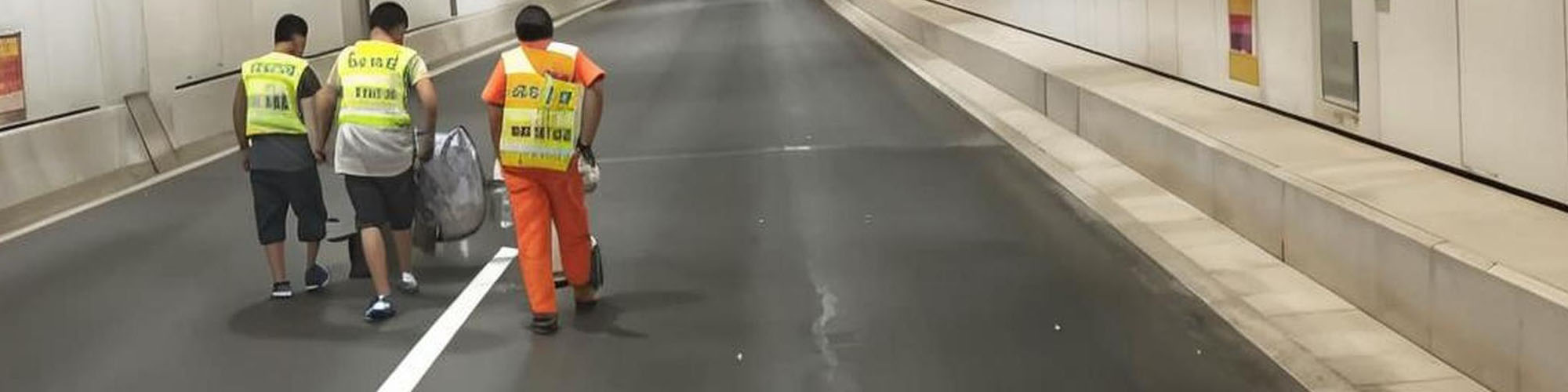
Among various types of road marking machines, hand-push and self-propelled models are the two most widely used categories. While the most obvious distinction lies in their power sources, the differences extend far beyond this, impacting everything from project scale to operator fatigue levels to marking precision.
1. Power Source and Mobility
Hand-push Road Marking Machine:
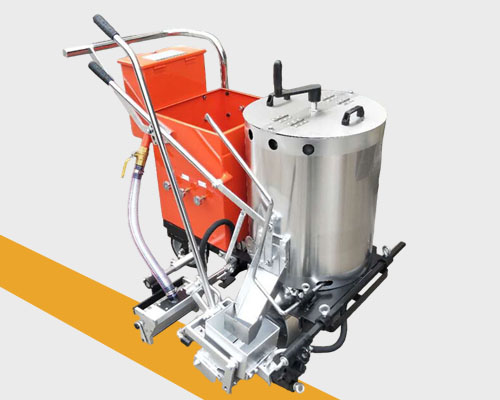
Mobility for hand-push machines relies entirely on human effort. Operators must exert force to propel the machine, which can be highly strenuous, especially over long distances or uneven terrain.
Self-Propelled Road Marking Machine:
Self-propelled machines are powered by internal combustion engines or electric motors, providing propulsion for movement. They offer simplified operation—the operator controls direction while the machine moves autonomously. Eliminating manual pushing reduces physical exertion and enables smoother, longer-distance operations.
2. Operational Intensity and Labor Demands
Hand-Push Road Marking Machine:
Using a hand-push machine involves higher labor intensity. Prolonged operation or heavy workloads can cause rapid operator fatigue, reducing efficiency and increasing exhaustion.
Self-Propelled Road Marking Machine:
Powered by an engine, this machine significantly reduces operator fatigue, boosting productivity and minimizing stress—especially during extended shifts.
3. Application Scope
Hand-Push Road Marking Machine:
Ideal for small-scale projects or confined areas requiring flexible operation. Examples include sidewalks, residential roads, temporary markings, and tight spaces like parking lots or crosswalks. Manual machines offer superior control precision, making them perfect for detailed, accurate line work in restricted environments.
Self-Propelled Road Marking Machine:
Designed for large-scale projects like highways, urban thoroughfares, and continuous long-distance markings. Self-propelled machines excel in projects demanding high efficiency and speed, covering extended distances rapidly without compromising accuracy.
4. Machine Design and Features
Hand-push Road Marking Machine:
These machines feature a simple design, typically being smaller, lighter, and easier to transport. Their straightforward construction keeps costs lower but also limits functionality. Without complex drive systems, maintenance and repair expenses are often minimal.
Self-Propelled Road Marking Machine:
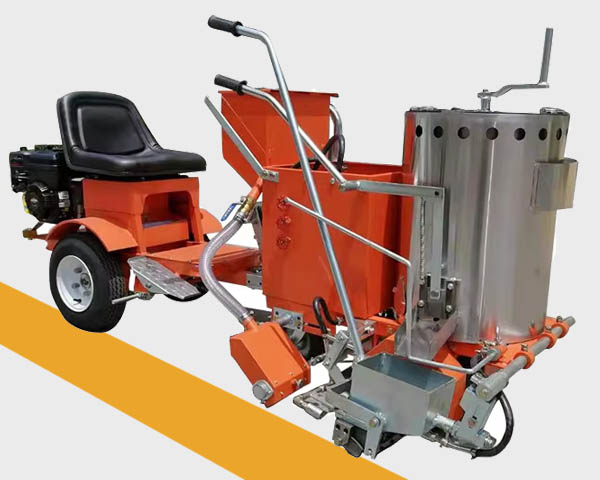
Self-propelled machines feature more complex structures, incorporating integrated engines, glass bead sprayers, speed regulation systems, and insulated material tanks. Operating costs for these machines are higher, including maintenance and repairs, as their advanced systems require specialized upkeep.
5. Operational Efficiency and Speed
Hand-push Road Marking Machine:
Operating speed primarily depends on the operator’s walking pace. Consequently, they work at a slower pace and are better suited for small-scale, localized tasks.
Self-Propelled Road Marking Machine:
These machines offer faster speeds and higher efficiency, with some models featuring adjustable speeds up to 5 km/h. Self-propelled road marking machines can rapidly cover large areas, significantly boosting overall efficiency. They are ideal for large-scale projects and high-traffic road construction.
6. Cost Considerations
Hand-push Road Marking Machine:
Hand-push machines are generally more affordable, with some models priced as low as 3,000 RMB. They are an ideal choice for budget-conscious businesses or contractors, as well as users undertaking small-scale projects.
Self-Propelled Road Marking Machine:
These machines command significantly higher prices, typically ranging from RMB 15,000 to RMB 50,000 depending on model and features.
The increased cost can be offset by higher productivity and reduced labor expenses, making self-propelled machines an excellent choice for large-scale operations.
7. Types of Road Marking Machines
Both hand-push and self-propelled machines can be categorized as either thermoplastic or cold-paint. Thermoplastic machines require heated materials for marking, while cold-paint machines use solvent-based or water-based coatings. Hand-push machines are more commonly used for thermoplastic markings, particularly for crosswalks; self-propelled machines are better suited for highway markings and two-component markings.
The choice between a hand-push or self-propelled road marking machine ultimately depends on the scale and nature of your project.