As an indispensable tool in road construction and maintenance, the choice of road marking machine is directly related to the clarity and durability of the road marking, as well as the overall efficiency and cost of the project. In order to ensure that the selected equipment can be a perfect fit for the project needs, the following are a few key factors to carefully consider when choosing a road marking machine.
Key factors to consider when choosing a road marking machine
1. Project Specific Requirements
First, conduct a detailed assessment of the work environment and the road marking targets:
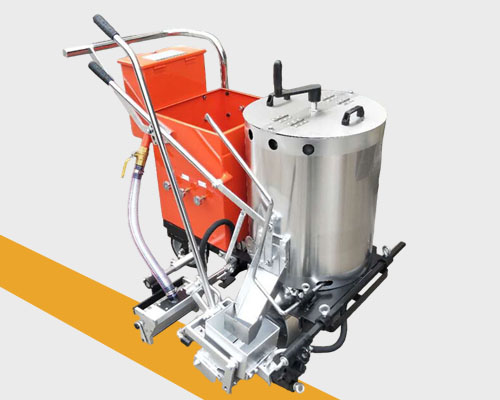
- Pavement type and condition: Asphalt pavement (porous, requiring high-viscosity paint), concrete pavement (smooth, requiring a primer), or epoxy-coated pavement (chemical compatibility is critical). For porous pavements, using a thermoplastic road marking machine with a preheating function ensures better melt penetration.
- Marking Geometry: Standard longitudinal lines (100–300 mm wide), transverse lines, symbols (arrows, crosswalks), or raised pavement markings. Ensure the machine supports adjustment of marking width through quick-change spray guns or squeegee assemblies.
- Traffic Volume and Curing Time: High-traffic roads demand rapid-cure paints (e.g., MMA—methyl methacrylate), which dry within 10–15 minutes. Select a machine with an integrated bead dispenser to enhance reflectivity and a forced-air drying system to accelerate curing.
Different project conditions require different performance from road marking machines, so a thorough understanding and accurate assessment of these needs is the cornerstone of making a sound choice.
2. Marking type and paint compatibility
Paint selection is also critical because it is directly related to the visibility, durability and cost-effectiveness of the marking.
- Thermoplastic Paint: Requires a thermoplastic road marking machine with a melting kettle (oil-jacketed or electrical), maintaining 180–220°C. Use a screw extruder or gear pump for consistent flow. Glass bead applicators must be synchronized with the spray pattern.
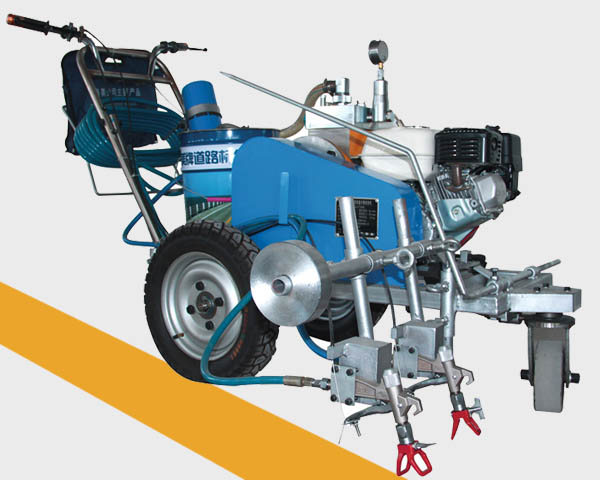
- Cold Paint (Solvent-Based or Waterborne): A cold paint road marking machine uses diaphragm or piston pumps (pressure up to 25 MPa) and airless spray tips (0.015–0.035 inch orifice). Waterborne paints need stainless steel components to prevent corrosion.
- Two-Component (PMMA/Epoxy): Requires a machine with dynamic mixing heads and proportional metering units (ratio accuracy ±1%) to avoid premature polymerization.
When choosing a road marking machine, it is important to make sure that the selected equipment is perfectly compatible with the type of coating used to ensure the best marking results and experience.
3. Functions and types of road marking machines
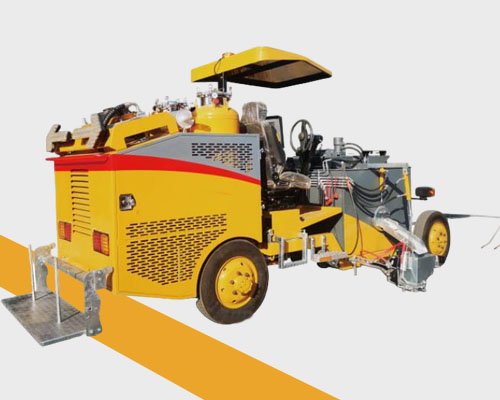
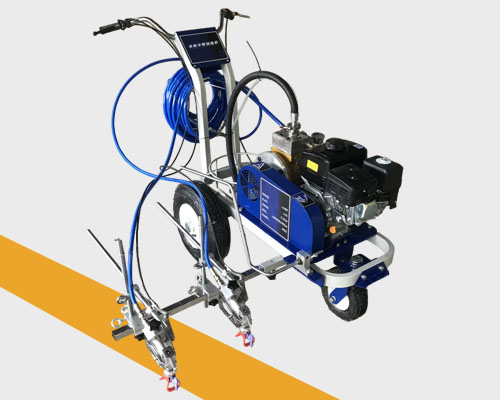
The diversity of equipment types and functions provides flexible choices for different application scenarios.
| Type | Best For | Key Specs | Productivity |
|---|---|---|---|
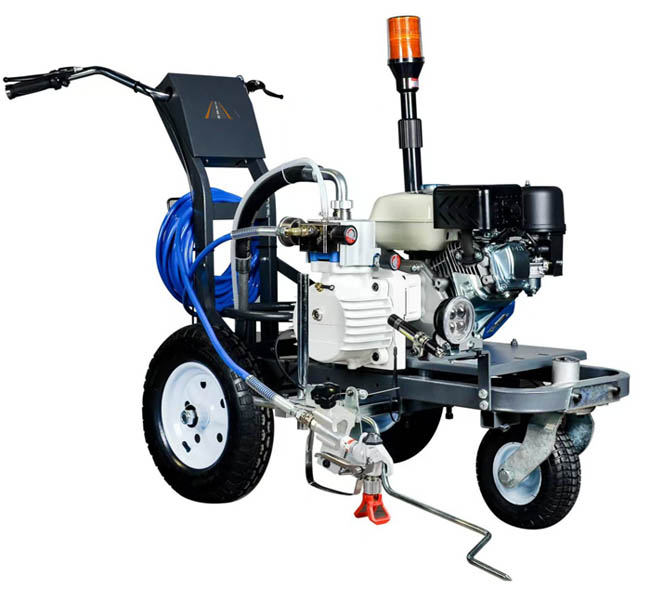
| Hand-Push Road Marking Machine | Small lots, indoor warehouses, touch-up work | Weight ≤80 kg, manual forward/backward, 2–4 nozzles | 200–600 m/h |
| Self-Propelled Road Marking Machine | Urban roads, medium-length runways | Hydraulic drive (0–8 km/h), automatic line guidance, 6–12 spray guns | 1500–5000 m/h |
| Truck-Mounted Road Marking Machine | Highways, large parking complexes | Engine-driven compressor (≥5 m³/min), telescopic boom (up to 6 m offset), 500–1000 L paint tank | 5000–12000 m/h |
According to the project requirements and operating environment, choose the most suitable type of equipment, and pay attention to whether it has advanced functions such as adjusting line width and paint flow to enhance operational efficiency and marking quality.
4. Workload and efficiency
Workload and efficiency are important indicators of road marking machine performance. For large or time-critical projects, equipment with high workload capacity can significantly accelerate the construction progress. At the same time, the equipment should have the ability to work efficiently, such as fast drying of paint, precise control of lines, etc., to ensure the clarity and durability of the marking. When selecting, the match between the working efficiency of the equipment and the needs of the project should be considered comprehensively.
5. Budget and long-term costs
Budget planning must take into account five years of operating costs:
- Energy consumption: Diesel heaters (thermoplastic) versus electric pumps (cold spray)—compare fuel consumption in kilowatt-hours (kW/h) or liters per hour (L/h). Electric equipment reduces emissions in indoor applications.
- Maintenance Intervals: Inspect piston cup seals (replace every 200–400 hours), nozzle wear (enlarged orifices reduce spray quality), and hydraulic oil change intervals. Equipment with modular components reduces spare parts inventory costs.
- Paint Wastage: High-precision pressure regulators and return line systems minimize coating waste (saving 5–15% in material costs annually).
- Resale Value: Brand-name equipment with complete maintenance records retains 30–50% of its value after three years.
ROI Calculation: Compare upfront costs with savings in labor costs (self-propelled equipment can reduce the number of operators from 4 to 2), paint costs, and reduced lane closures (particularly important for highway projects where downtime costs can reach $500 per hour).
6. Training and support
Training and support services are key to ensuring efficient operation and long equipment life. Choosing a road marking machine manufacturer or distributor that provides comprehensive training, timely technical support and reliable after-sales service can help operators quickly master the skills of using the equipment, improve operational efficiency, and when problems are encountered, quickly get a solution to reduce downtime and lower operating costs.
Final Decision Matrix
| Criterion | Weight | Evaluation Method |
|---|---|---|
| Paint compatibility & heating system | 25% | Test with actual paint sample at dealer facility |
| Productivity vs. deadline | 20% | Calculate daily required meterage vs. machine max speed |
| Total cost over 3 years | 20% | Request maintenance cost history from existing users |
| After-sales support proximity | 15% | Confirm local service center response time (<24h) |
| Operator skill level | 10% | Assess learning curve (touchscreen vs. manual controls) |
| Resale & upgradability | 10% | Check if machine can be retrofitted with GPS or IoT modules |
In summary, choosing a road marking machine is a decision-making process that integrates many factors. By understanding the project requirements, evaluating paint compatibility, comparing equipment features and types, considering workload and efficiency, planning budgets, and paying attention to training and support services, you can ensure that the equipment you select can maximize project requirements and improve the quality and efficiency of road marking.