
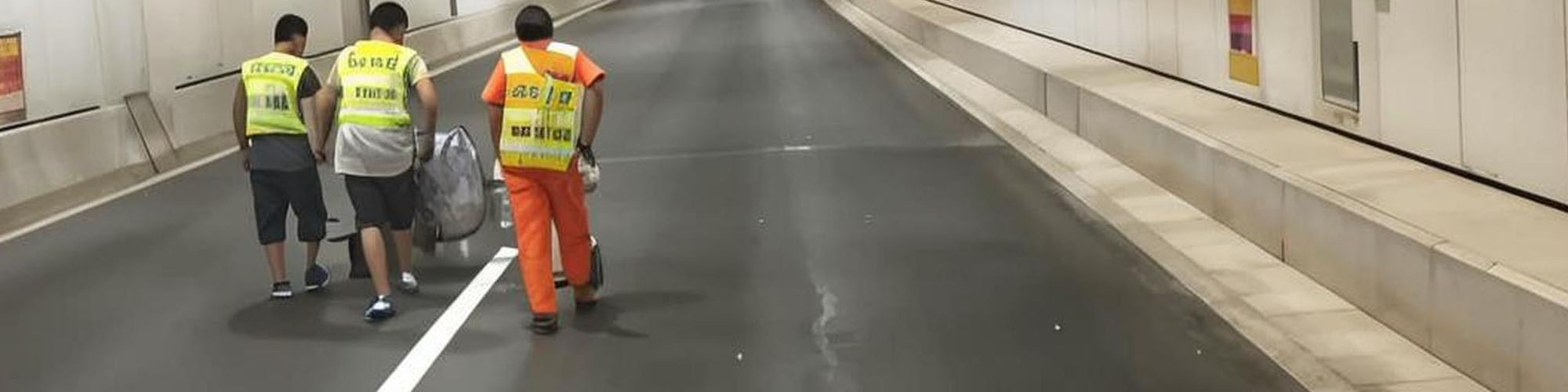
Choosing the correct thermoplastic melting kettle is a foundational decision for any road marking operation. The melting kettle—often the largest and most energy-intensive component of a thermoplastic road marking machine setup—determines preheating throughput, temperature uniformity, and the consistency of the molten material delivered to the applicator. The following analysis examines the principal configurations available on the market, with attention to the technical trade-offs that influence job-site performance.
1. Classification by Kettle Configuration: Single versus Dual Chamber
The number of independent melting chambers directly governs batch scheduling flexibility and material changeover time.
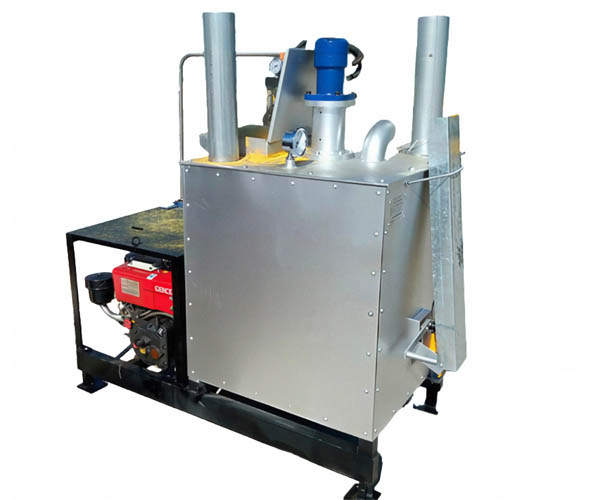
Single-kettle thermoplastic melting kettles incorporate one heated chamber, with common capacities ranging from 300 kg to 800 kg. These units melt and agitate one material formulation at a time. Their compact footprint makes them suitable for lane closures, urban intersections, and smaller parking lot projects where material variety is limited. The primary limitation is operational: switching between formulations—for example, from standard white to yellow, or from a flat-line compound to a profiled marking material—requires a full melt-down and cleaning cycle, which can add 45 to 90 minutes of non-productive time depending on capacity and heating input.
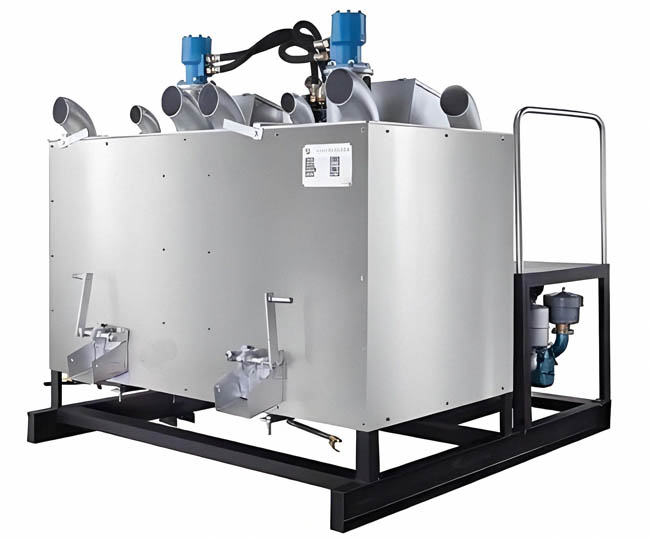
Dual-kettle thermoplastic melting kettles house two independent chambers, typically configured as 300 kg × 2, 500 kg × 2, or 600 kg × 2. The operational advantage is substantial for highway and large-scale municipal work: two distinct materials can be maintained at application temperature simultaneously, eliminating changeover downtime. Dual-kettle units also provide redundancy—if one chamber requires maintenance or cleaning, production continues on the second chamber. For contractors running high-volume thermoplastic road marking machine fleets, the reduced idle time typically justifies the higher capital cost within a single construction season.
2. Agitation Systems: Mechanical versus Hydraulic Drive
Agitation is not merely a mixing function; it is the primary mechanism for ensuring homogeneous heat transfer within the molten thermoplastic. Without continuous agitation, thermoplastic compounds—which contain resin, glass beads, pigment, and filler—stratify and develop hot spots that degrade the binder and produce inconsistent line appearance.
Mechanical agitation uses a gear-driven or clutch-engaged system that rotates the agitator in a single direction. The design is simple, robust, and inexpensive to maintain. However, single-direction rotation creates a persistent flow pattern that can leave unmelted material accumulating in dead zones near the kettle walls and bottom plate. Operators must manually adjust throttle settings to vary mixing intensity, which introduces variability between crews and shifts.
Hydraulic agitation employs a hydraulic motor—typically a BM-type motor with a multi-way integrated valve—that enables stepless forward and reverse speed regulation. This bidirectional capability is technically significant for thermoplastic processing. Alternating rotation direction disrupts the boundary layer at the heated kettle surface, improving heat transfer coefficient and reducing the risk of localized thermal degradation. Operators can adjust agitation intensity according to material viscosity: slower, gentler mixing for fine-aggregate formulations that shear-thin under high agitation, and faster mixing for high-viscosity or high-filler compounds. Hydraulic systems also deliver smoother torque delivery under load and can, on certain models, supply molten material to two separate thermoplastic road marking machine applicators simultaneously—a meaningful productivity gain on multi-lane closures.
The trade-off is cost. Hydraulic melting kettles carry higher purchase prices and require more rigorous maintenance discipline—hydraulic fluid condition, filter replacement, and valve inspection—compared with mechanical units. For contractors whose annual throughput is modest or whose material formulations rarely change, mechanical agitation remains a defensible choice.
3. Heating Methods and Thermal Performance
Heating method affects melt rate, temperature stability, and fuel logistics. The dominant configurations are direct-fired burner systems using propane (LPG) or diesel, with the burner flame directed into a combustion chamber beneath the kettle bottom and hot gases routed through side heat stacks to improve thermal efficiency.
The thermal profile within a melting kettle is inherently non-uniform: the kettle bottom, closest to the combustion chamber, is the hottest surface, while the upper region of the melt is coolest. This gradient is why agitation strategy and kettle geometry matter as much as burner capacity. Some advanced designs incorporate a central heat riser or circulation system that draws cooler material from the top of the melt and returns heated material from the bottom, reducing stratification and accelerating overall melt rate.
Temperature control precision is another differentiator. Entry-level kettles rely on manual throttle and thermometer observation, while professional-grade thermoplastic melting kettles use digital temperature controllers with thermocouple feedback and safety shutoff valves that cut fuel supply if combustion is lost or temperature exceeds setpoint. For thermoplastic materials with narrow application windows—typically 180°C to 220°C—this precision directly affects line quality and adhesion.
4. Fuel and Power Source Considerations
Propane-fired kettles offer portability and consistent heat output without dependence on onboard engine power. Diesel-fired units provide higher energy density per unit volume and may be preferable where LPG refueling logistics are constrained. Some configurations use a propane engine to drive the hydraulic pump independently of the towing vehicle, allowing the kettle to maintain agitation and temperature during transport or staging.
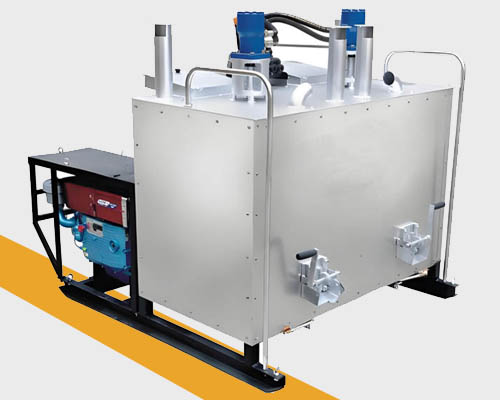
Selection Summary
| Criterion | Single Kettle | Dual Kettle | Mechanical Agitation | Hydraulic Agitation |
|---|---|---|---|---|
| Best for | Small/medium jobs, single material | Highway, multi-material | Budget-sensitive, simple maintenance | High-viscosity, precision, dual applicator supply |
| Key limitation | Changeover downtime | Higher weight and cost | Single-direction flow, dead zones | Higher capex and maintenance complexity |
Investing in the appropriate thermoplastic melting kettle configuration is not merely a capital equipment decision—it is a determinant of daily production rate, material yield, and marking consistency. Contractors should match kettle capacity and agitation capability to their typical project profile rather than defaulting to the lowest-cost option, as the operational penalties of undersized or under-agitated equipment manifest as rework, delayed lane openings, and accelerated material degradation.
If you are evaluating thermoplastic road marking machine configurations or require application-specific guidance on kettle sizing and agitation specifications, our technical team is available to support your project planning.
FAQ
Q1: What is the difference between a thermoplastic melting kettle and a preheater?
A thermoplastic melting kettle performs both melting and continuous agitation to maintain homogeneity. A preheater may only raise material temperature without active mixing, relying on the applicator’s agitation for final homogenization. Kettles with hydraulic bidirectional agitation provide superior temperature and consistency control.
Q2: Can a single-kettle unit be upgraded to dual-kettle capability?
Generally no. Dual-kettle units have independent heating chambers, burners, and agitation drives. Retrofitting a single-kettle thermoplastic road marking machine to dual configuration is not economically or structurally practical.
Q3: How does hydraulic agitation improve marking quality?
Bidirectional hydraulic agitation reduces thermal gradients and prevents filler settling. Uniform melt viscosity translates to consistent extruded line thickness and bead embedment, particularly important on high-speed thermoplastic road marking machine applications where dwell time between kettle and shoe is brief.
Q4: What capacity kettle is appropriate for a typical highway striping crew?
For continuous highway work with a truck-mounted applicator, a dual-kettle configuration of 500 kg × 2 or larger is commonly specified to maintain supply during long passes and to allow one chamber to reheat while the other dispenses. Smaller municipal crews often operate effectively with a 300 kg to 600 kg single kettle.